Following Futures Signals Through a Contract Roll
Track actual expiries, closing and opening fills, price-series conventions and settlement without turning a continuous chart into a broker ledger.
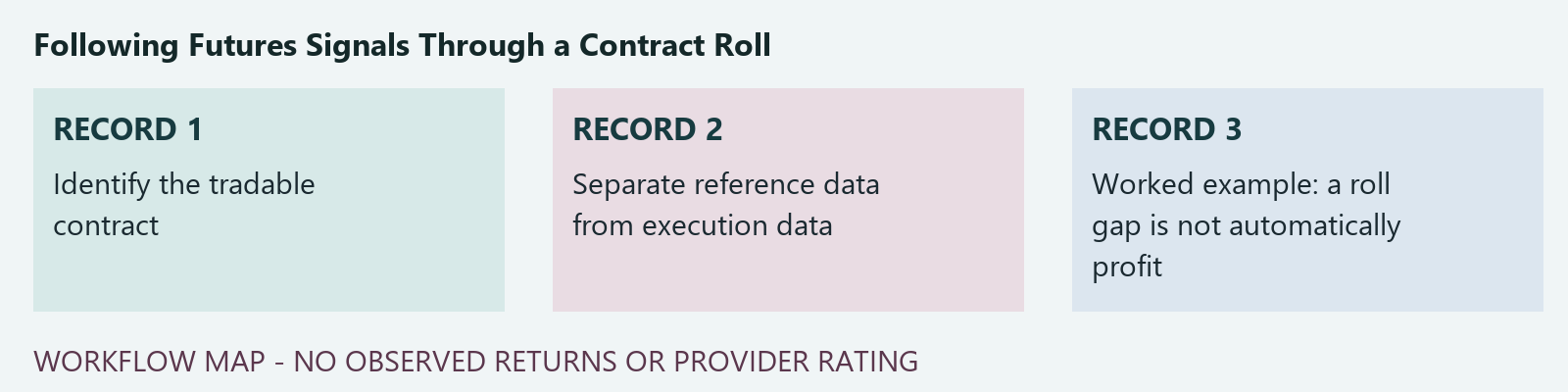
Identify the tradable contract
Record product root, exchange, expiry, multiplier, tick size and tick value from the dated contract specification. A continuous-chart label is not an individual listed contract. Two contracts in the same family can have different prices while referencing the same underlying market. A provider instruction should name which exposure the subscriber is meant to take. Do not infer a contract month, quantity or broker availability from a convenient chart symbol; missing identity fields should remain unresolved in the comparison.
Separate reference data from execution data
State whether a historical series is individual-contract, continuous unadjusted, back-adjusted or another constructed reference. A continuous research series can support a labelled research question without claiming actual-contract executions. Preserve roll dates, adjustment rules and source coverage. CME tick documentation provides the specification vocabulary, not a completed historical contract mapping. A price on a constructed chart should not be presented as a broker fill unless the account evidence separately establishes that fill and instrument.
Worked example: a roll gap is not automatically profit
Invent a nearby contract closing at 100 and a later contract quoted at 103 when exposure is rolled. Selling the nearby and buying the later changes the instrument and its price reference. The three-unit difference is not automatically a trading gain on the original position, and a chart splice can create a misleading apparent movement. Record actual old-close and new-open fills, quantity and fees. This example does not describe current market contango, a real contract spread or a measured provider result; it isolates the accounting question.
Record expiry and settlement obligations
Ask about the applicable final trading, settlement and delivery rules for the exact contract and broker. Do not substitute a generic month-end assumption. A provider's planned roll can differ from the broker's account restrictions or the subscriber's actual action. Keep remaining exposure visible if only part of the position was rolled. An unfilled replacement order creates a different state from a completed roll, while two overlapping contracts can create temporary additional exposure.
Keep margin and costs on the event trail
Record the funding requirement for both contracts where overlap exists and retain commissions, spread conventions and any other account charges. CME margin material defines general mechanisms; current account requirements need their own source. Planned stop-distance loss and required margin should not be conflated. A low intraday requirement does not establish safe overnight funding or a maximum loss. Do not complete a performance table by inventing current broker charges or assuming the replacement filled at the chart's displayed level.
Review the full contract family
Join the original alert, amendments, old-contract close, replacement open and final settlement or exit. Publish the data-class distinction beside each result: research reference, provider-reported convention or actual account trail. A futures comparison can be useful without a tested ranking if it makes contract identity and record limits clear. This chapter supplies a roll-review protocol and fictional example, not a paid-provider test. It helps readers avoid a precise-looking return calculation whose underlying prices refer to different, incompletely specified instruments.
Decision record
| Question | Record to retain | Decision boundary |
|---|---|---|
| Contract | Expiry, specification and broker instrument ID | A root symbol does not name the actual position |
| Series | Roll and adjustment conventions | Continuous reference is not actual-contract execution |
| Roll event | Old close, new open, quantity and charges | A splice gap is not automatically profit |
| Funding | Requirements during overlap and after transition | Margin is not a guaranteed loss bound |
Blank working record
The worksheet contains column headings only. Enter your own dated observations, keep absent evidence marked unknown, and do not treat the file as certification.
 Download worksheet (CSV)
Primary references
- CME: tick movements and contract specifications
- CME: performance bonds and margin
- SEC: order types and execution limitations
These documents support mechanisms and source definitions, not a tested trading result or a recommendation. Accessed 9 October 2026. The decision workflow and invented examples above are editorial exercises.
Keep reading
Publication methodology | Working glossary | Source and correction policy
A completed example alongside the blank worksheet
Fictional old month A enters at 100 and closes at 102 with declared value 10 per point and quantity one: gross component +20. New month B opens at 105 and later closes at 104: component -10. Declared whole-history charges of 4 leave +6 across these two separate components. The blank CSV remains available for actual observations; these rows are an educational example, not a certification or dataset of provider trades.
Keep both contract months and price bases in the record. The difference between the roll prices is not an extra realised trade by itself. Include any temporary unmatched quantity and retain the actual receipts if supplied. The continuous chart can be a research reference but does not replace these transactions or establish either execution price.